

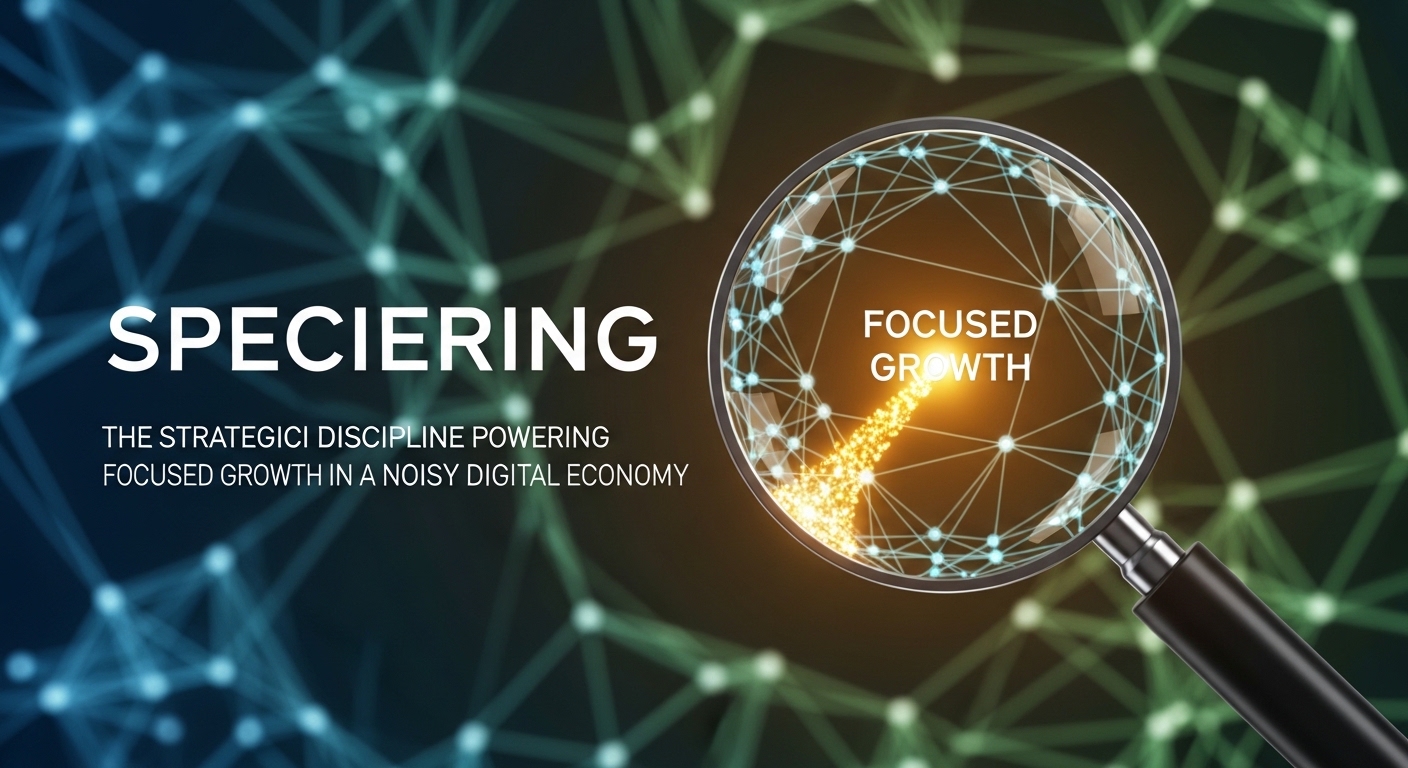
In a world where every startup is told to scale faster, launch sooner, and be everywhere at once, many founders are quietly running into the same invisible wall. Their products are good, their teams are talented, and their markets are growing—but traction feels scattered. This is where speciering enters the conversation. More than a buzzword, speciering is an emerging strategic discipline that helps modern organizations decide what not to do so they can execute what truly matters with clarity and force.
At its core, it is about intentional focus in complex environments. It recognizes that growth is rarely blocked by a lack of ideas. Instead, it’s slowed by diluted attention, overlapping priorities, and unclear strategic identity. For founders, entrepreneurs, and tech leaders navigating constant change, speciering offers a way to cut through noise and build momentum without burning out teams or customers.
Understanding Speciering in Practical Terms
It is the process of deliberately narrowing strategic scope to amplify impact. It’s not about limiting ambition; it’s about channeling it. When companies practice speciering, they choose a clear strategic lane—defined by a specific customer, problem, or outcome—and align decisions around that choice.
In practice, speciering shows up in how products are designed, how teams allocate time, and how leaders communicate priorities. A startup that specializes too broadly often feels busy but unfocused. One that embraces speciering, on the other hand, may do fewer things, but each move compounds toward a clear objective.
This discipline matters more now than ever because digital businesses operate in environments with near-infinite optionality. The ability to say “yes” to everything has become a liability. Speciering reframes focus as a competitive advantage rather than a constraint.
Why Speciering Resonates with Modern Founders
Startup culture has long celebrated speed and experimentation. While those values remain important, many founders discover that endless iteration without direction leads to exhaustion and strategic drift. Speciering resonates because it introduces intentionality into experimentation.
Rather than testing everything, it encourages leaders to ask sharper questions. customer segment truly defines our future? Which capability differentiates us rather than just keeps us busy? metrics actually reflect progress instead of vanity?
By answering these questions, founders move from reactive execution to purposeful growth. Speciering doesn’t slow innovation; it ensures innovation serves a coherent strategy instead of fragmenting it.
Speciering vs. Generalization: A Strategic Comparison
To understand the value of speciering, it helps to contrast it with generalized growth strategies that dominate many early-stage companies.
| Strategic Dimension | Generalized Approach | Speciering Approach |
|---|---|---|
| Product Direction | Multiple features for many users | Fewer features for a defined core user |
| Team Focus | Distributed across initiatives | Aligned around a single priority |
| Decision-Making | Reactive to opportunities | Guided by strategic filters |
| Brand Identity | Broad and ambiguous | Clear and differentiated |
| Growth Quality | Wide but shallow | Narrow but deep |
This comparison highlights why speciering often leads to stronger long-term outcomes. Depth creates defensibility. Clarity builds trust. Focus enables teams to execute with confidence instead of constant second-guessing.
Speciering as an Execution Multiplier
One of the most overlooked benefits of speciering is its impact on execution. Teams that lack focus tend to over-communicate, over-meet, and under-deliver. Every decision requires negotiation because priorities aren’t clear.
It simplifies execution by reducing decision fatigue. When the strategic lane is defined, many decisions become obvious. Teams know which projects deserve attention and which distractions should be ignored. This clarity accelerates momentum and improves morale.
For tech professionals especially, it provides relief from context switching. Engineers, designers, and product managers perform best when they can go deep. Speciering gives them permission to focus without fear that they’re missing the “next big thing.”
How Speciering Shapes Product Strategy
Product strategy is where speciering becomes tangible. Instead of building for hypothetical future users, teams practicing speciering obsess over a specific use case. They design experiences that feel intentional rather than bloated.
This doesn’t mean products can’t evolve. It means evolution happens outward from a strong core, not sideways in every direction. Companies that embrace speciering often find that their products become easier to explain, easier to market, and easier to improve.
Customers notice this difference. A product shaped by speciering feels like it understands them. That emotional resonance is difficult to replicate and often becomes a company’s strongest moat.
Speciering and Organizational Alignment
As startups grow, alignment becomes harder. New hires bring new ideas, and without a shared strategic anchor, those ideas pull the company apart. It acts as that anchor.
When leaders articulate what the organization is specializing in—and just as importantly, what it is not—teams gain a shared language for prioritization. Meetings become shorter. Roadmaps become clearer. Conflicts resolve faster because decisions are grounded in strategy rather than opinion.
Speciering also empowers middle managers. Instead of escalating every decision upward, they can act autonomously within a well-defined scope. This autonomy is critical for scaling without losing speed.
The Role of Leadership in Practicing Speciering
It is ultimately a leadership discipline. It requires courage to focus when external pressure pushes expansion. Investors ask about new markets. Customers request additional features. Competitors experiment loudly.
Leaders who practice It listen to all of this input—but filter it through a clear strategic lens. They communicate focus repeatedly, even when it feels repetitive. Over time, that consistency builds trust internally and externally.
Importantly, speciering is not static. Leaders revisit strategic focus as markets evolve. The difference is that change is deliberate, not reactive. It allows organizations to adapt without losing identity.
Speciering in a Platform-Driven Economy
In today’s platform-driven economy, the temptation to become everything to everyone is strong. APIs, integrations, and modular architectures make expansion technically easy. It ensures that expansion remains strategically sound.
Platforms that succeed long-term usually start by specializing deeply in one problem before broadening. Speciering helps companies recognize when they have earned the right to expand—and when doing so would dilute value.
For digital readers and tech professionals, this perspective reframes scalability. True scale isn’t just about reach; it’s about replicating excellence. It creates the conditions for that replication.
Measuring Success Through a Speciering Lens
Traditional metrics often reward activity over impact. It encourages leaders to redefine success metrics around depth rather than breadth. Engagement quality, retention strength, and customer advocacy become more meaningful than raw acquisition numbers.
This shift doesn’t reduce ambition. It refines it. By measuring what truly matters, teams avoid chasing hollow wins and instead build sustainable growth engines.
Over time, organizations that practice it often discover an unexpected benefit: resilience. Focused companies adapt better because they understand their core value deeply. When conditions change, they know what must be preserved and what can evolve.
The Future of Speciering as a Business Discipline
As markets become more crowded and attention more fragmented, speciering will likely move from an emerging concept to a foundational one. Founders who master it early will build companies that feel calm in chaos and confident in uncertainty.
It aligns strategy, execution, and culture around a shared sense of purpose. It replaces frantic growth with intentional progress. For modern leaders, that shift may be the difference between scaling successfully and simply staying busy.
Conclusion: Why Speciering Matters Now
Speciering is not about doing less for the sake of simplicity. It’s about doing the right things with conviction. In a digital economy overflowing with options, focus has become the rarest resource.
For startup founders, entrepreneurs, and tech professionals, it offers a path to clarity without rigidity and growth without exhaustion. It transforms focus into a strategic asset and execution into a competitive advantage. In the long run, companies that embrace it won’t just grow faster—they’ll grow smarter.