

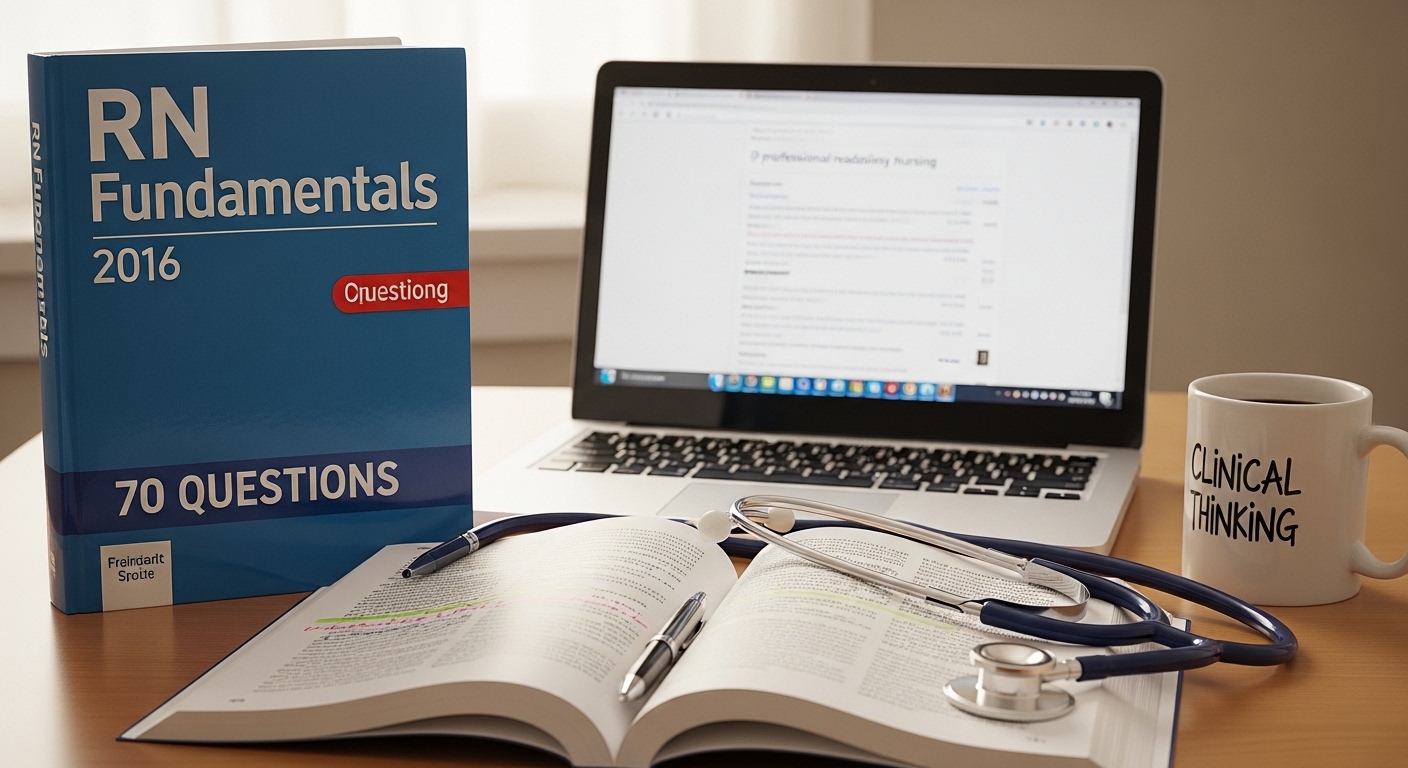
The rn fundamentals 2016 70 questions format is structured as a comprehensive assessment designed to evaluate whether a student understands those foundational principles in applied, real-world scenarios.Unlike memorization-heavy exams, fundamentals assessments test:
-
Clinical judgment
-
Prioritization
-
Delegation awareness
-
Safety protocols
-
Ethical decision-making
In business terms, think of this as your operating system. If fundamentals are weak, every advanced skill built on top of them becomes unstable.
Why the 2016 70-Question Format Still Holds Value
You may wonder: why does a 2016 question set still circulate?
The answer is simple. Core nursing fundamentals do not change dramatically year to year. Infection control remains infection control. Safe medication administration still follows the same foundational rights. Patient dignity and documentation standards remain consistent.
The 70-question format is particularly effective because it simulates a focused, mid-length exam environment. It is long enough to test depth but short enough to maintain cognitive intensity.For professionals used to sprint-based workflows, this is comparable to a strategic audit. It forces you to engage deeply for a defined period without distraction.
Core Topics Covered in RN Fundamentals 2016 70 Questions
The exam format typically includes scenario-based multiple-choice questions. These are not random. They follow predictable domains that reflect professional competency expectations.
Here is a simplified overview:
| Core Domain | What It Tests | Real-World Application |
|---|---|---|
| Infection Control | Isolation protocols, PPE, sterile technique | Preventing hospital-acquired infections |
| Patient Safety | Fall prevention, restraints, environment setup | Risk mitigation in care settings |
| Basic Care & Comfort | Hygiene, positioning, nutrition | Maintaining patient dignity and recovery |
| Documentation | Charting accuracy, legal implications | Compliance and communication clarity |
| Medication Basics | Rights of administration, error prevention | Safe pharmacological support |
| Communication | Therapeutic communication techniques | Building patient trust |
| Delegation | Scope of practice awareness | Team coordination and efficiency |
Each of these domains reflects operational excellence in healthcare environments. Just as founders must understand finance, operations, and customer engagement, nurses must master these baseline skills before advancing.
How to Approach RN Fundamentals 2016 70 Questions Strategically
Let’s shift from what it is to how to win it.The biggest mistake students make when tackling the rn fundamentals 2016 70 questions is overcomplicating the scenario. Fundamentals exams reward simplicity and safety.
When evaluating an answer choice, ask:
-
Which option protects patient safety first?
-
Which action aligns with scope of practice?
-
Which choice reflects least harm?
In early-stage nursing exams, the safest answer is often correct. This mirrors early-stage product decisions in startups. When uncertainty exists, choose the path that minimizes risk exposure.
Another key strategy is understanding prioritization frameworks. For example, airway, breathing, and circulation (ABC) principles often guide which patient to assess first. Maslow’s hierarchy may influence which need is most urgent.When reviewing practice sets from 2016, look for patterns. Fundamentals questions frequently test:
-
First action steps
-
Best response statements
-
Most appropriate delegation
-
Correct documentation phrasing
Recognizing patterns reduces cognitive load and improves speed.
Clinical Judgment Over Memorization
Fundamentals exams assess:
-
Risk identification
-
Professional boundaries
-
Ethical reasoning
-
Practical response under pressure
That is why reviewing rationales matters more than simply checking correct answers.
Delegation and Scope: A Hidden Leadership Lesson
One area that often challenges test-takers in the rn fundamentals 2016 70 questions is delegation.Delegation questions typically present a scenario involving an RN, LPN, and nursing assistant. The test measures whether you understand what can and cannot be delegated safely.
This is not just academic. It is a leadership competency.In healthcare, improper delegation can lead to patient harm and legal liability. In startups, poor delegation leads to operational breakdowns. In both contexts, leaders must know:
-
What tasks require expert oversight
-
What tasks can be safely transferred
-
When supervision is required
Fundamentals exams subtly test whether you are ready to operate responsibly within a team structure.
Common Pitfalls to Avoid
Many students preparing for the rn fundamentals 2016 70 questions fall into predictable traps.
First, they overthink simple hygiene or safety questions. If a patient is at risk of falling, the correct answer usually involves prevention, not documentation.
Second, they ignore keywords like “first,” “priority,” or “most appropriate.” These words determine the decision hierarchy.
Third, they underestimate communication questions. Therapeutic communication answers are almost always open-ended, supportive, and nonjudgmental.
If an answer choice includes personal opinion, reassurance without validation, or closed-ended dismissal, it is likely incorrect.
Time Management and Mental Endurance
Seventy questions may not sound overwhelming, but mental fatigue builds quickly under timed conditions.A strong approach includes:
-
Completing easier questions first
-
Marking uncertain items for review
-
Avoiding excessive time on a single scenario
In professional life, stamina often differentiates high performers from average ones. The same principle applies here.Cognitive pacing is a skill.Practice sets from 2016 remain useful precisely because they simulate this pacing requirement.
How This Exam Reflects Real Clinical Readiness
Fundamentals exams are not about tricking students. They are about ensuring baseline competence before exposure to complex clinical environments.If you strip away academic framing, the rn fundamentals 2016 70 questions evaluate whether you can:
-
Protect a vulnerable person
-
Recognize unsafe practice
-
Communicate professionally
-
Document accurately
-
Work within scope
Those are not small responsibilities. They are the bedrock of healthcare delivery.Just as investors assess whether founders understand cash flow before scaling, nursing educators assess whether students understand safety before clinical independence.
Is Using Older Question Sets Still Smart?
Yes, with context.While clinical guidelines evolve, foundational safety principles rarely shift dramatically. A 2016 fundamentals exam still accurately reflects core nursing priorities.
However, it should not be your only resource. Pair it with updated coursework and institutional guidelines. Think of it as reviewing a classic playbook. The fundamentals stay consistent even if minor rules change.
The Bigger Lesson: Master the Basics Relentlessly
There is a reason fundamentals are called fundamentals.
In tech, security basics prevent breaches.
d=”9467″ />>In healthcare, fundamentals prevent harm.
The rn fundamentals 2016 70 questions are more than a study tool. They are a reminder that expertise is built from disciplined mastery of essentials.When you approach these questions with structured thinking, risk awareness, and patient-first logic, you are not just preparing for an exam. You are training your professional instincts.And that mindset extends far beyond nursing.
Conclusion:
The rn fundamentals 2016 70 questions format remains a powerful benchmark for assessing core nursing competence. It tests clinical reasoning, safety prioritization, ethical communication, and delegation judgment in a focused, realistic way.
ata-end=”10426″>For students, it builds exam confidence.
ata-end=”10256″ />>For professionals, it reinforces essential practice standards.
>For anyone in a high-responsibility field, it underscores a <strong>universal truth: fundamentals are everything.
If you master the basics thoroughly and consistently, advanced skills become easier, safer, and more effective.That is not just a nursing principle.Therefore it is a professional one.