

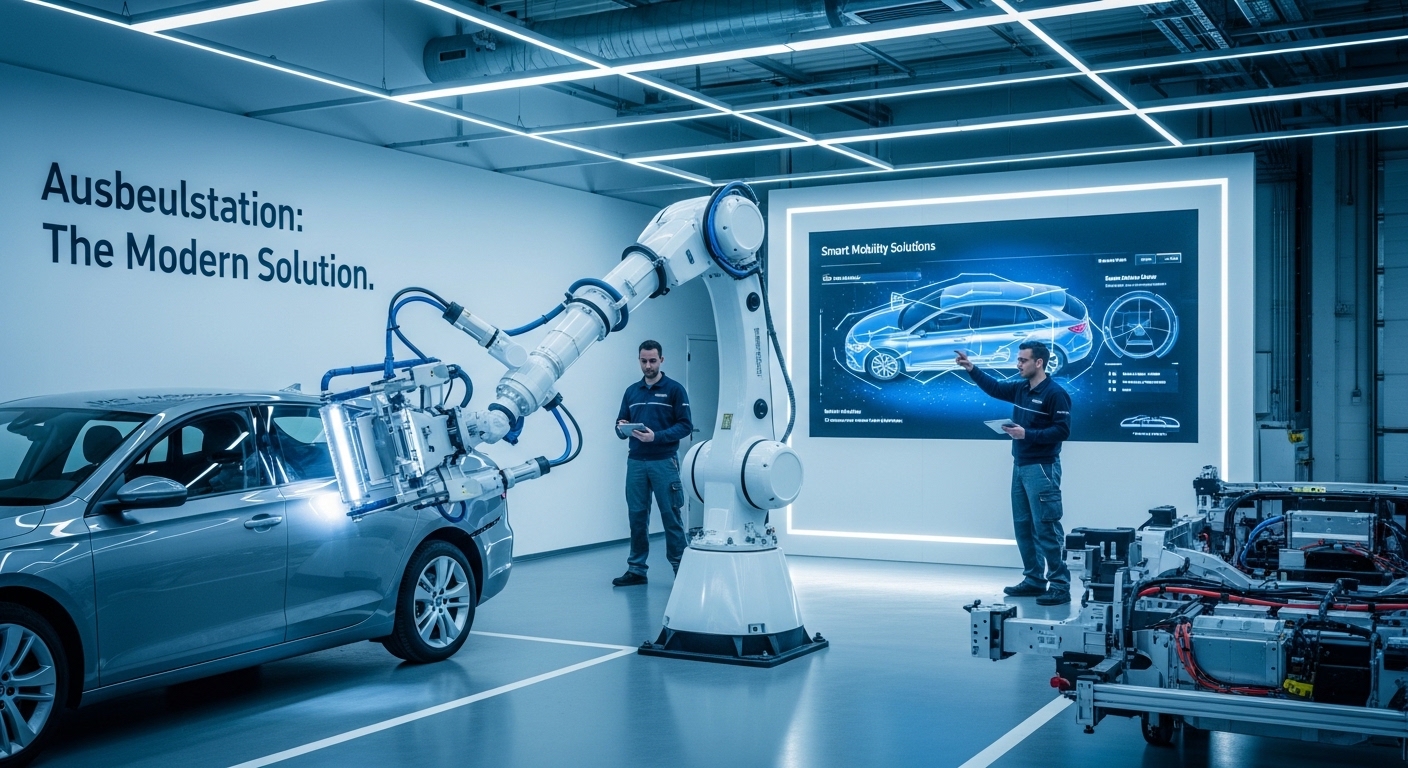
When you look at a car, you see more than metal and paint. You see mobility, investment, freedom, and in many cases, identity. So when a dent appears whether from a parking lot mishap, hailstorm, or minor collision it feels bigger than the damage itself. That’s where an ausbeulstation steps in.
An ausbeulstation is not just a repair shop. It represents a smarter, more efficient evolution in automotive restorationcombining craftsmanship, technology, and customer-centric service into a streamlined solution for modern drivers.
For startup founders, entrepreneurs, and tech professionals watching the rapid digitization of traditional industries, the rise of the ausbeulstation offers an interesting case study. It shows how even established sectors like auto repair are being reshaped by innovation, operational efficiency, and customer experience design.Let’s explore how.
What Is an Ausbeulstation?
An ausbeulstation literally translated from German as “dent removal station” is a specialized facility focused on repairing dents, dings, and body damage without requiring full panel replacements or extensive repainting.
Unlike traditional body shops that may rely on time-intensive processes, modern ausbeulstation services often utilize techniques such as paintless dent repair (PDR). This method carefully reshapes the metal from behind the panel, preserving the original paint and reducing both cost and environmental impact.
The concept originated in Europe, where efficiency and precision engineering are deeply embedded in automotive culture. Today, the model is spreading globally, aligning perfectly with a world that values sustainability, speed, and digital convenience.
The Business Innovation Behind the Ausbeulstation Model
From a business perspective, the ausbeulstation model is fascinating because it challenges legacy automotive repair frameworks.Traditional repair shops operate with high overhead: large facilities, paint booths, extended repair timelines, and complex insurance negotiations. An ausbeulstation, by contrast, focuses on specialization. It narrows its scope to dent repair excellence, which enables:
-
Faster turnaround times
-
Lower material costs
-
Reduced labor intensity
-
Higher customer throughput
This specialization creates operational leverage. Instead of trying to do everything, the ausbeulstation becomes the best at one thing. And in today’s economy, specialization often wins.For founders and operators, this reflects a broader startup principle: narrow your focus, master your niche, then scale.
Technology as a Competitive Advantage
What truly differentiates a modern ausbeulstation is the integration of technology.Digital diagnostic tools, high-intensity LED lighting systems for precision dent mapping, and advanced leverage tools allow technicians to detect and repair damage that would have been invisible or irreparable decades ago.Even more compelling is the digital customer journey. Many ausbeulstation businesses now offer:
-
Online damage assessments via uploaded photos
-
AI-assisted cost estimates
-
Digital scheduling platforms
-
Real-time repair status updates
The result? A frictionless experience that mirrors what customers expect from fintech apps or SaaS platforms.For entrepreneurs, this signals an important insight: every “traditional” industry is now a tech industry.
Sustainability and Environmental Impact
Sustainability is no longer a branding afterthought ,it’s a business imperative.One of the hidden strengths of the ausbeulstation model is its environmental efficiency. Traditional body repair often requires sanding, repainting, and chemical treatments that generate waste and emissions. Paintless dent repair significantly reduces:
-
Chemical usage
-
Paint consumption
-
Energy-intensive curing processes
-
Replacement parts manufacturing
This aligns perfectly with ESG-focused companies and eco-conscious consumers.For investors and startup operators, sustainability isn’t just ethical it’s strategic. Businesses that lower their carbon footprint while lowering operational costs sit in a powerful competitive position.
Customer Experience: The Silent Growth Driver
In the age of instant gratification, customers do not tolerate long, opaque repair timelines.A modern ausbeulstation builds its growth engine around transparency and speed. Instead of multi-week repairs, many dents can be resolved in hours or days. Instead of vague estimates, customers receive clear digital pricing.
This shift transforms a stressful situation into a manageable one.Think about it from a brand-building standpoint. If a customer’s car is damaged, emotions are already heightened. The business that provides calm, clarity, and fast results becomes memorable.And memorable businesses scale.
Comparing Traditional Repair Shops and an Ausbeulstation
To understand the efficiency advantage, let’s compare the two models.
| Factor | Traditional Body Shop | Ausbeulstation |
|---|---|---|
| Primary Focus | Full-body collision repair | Dent and minor damage repair |
| Repair Method | Sanding, repainting, part replacement | Paintless dent repair & precision reshaping |
| Average Turnaround | Several days to weeks | Same day to a few days |
| Environmental Impact | High (paint, chemicals, parts) | Lower (minimal materials used) |
| Cost to Customer | Higher | More cost-effective |
| Digital Integration | Varies widely | Often tech-enabled & streamlined |
This isn’t to say traditional body shops are obsolete. They remain essential for major structural damage. But for minor to moderate dents, the ausbeulstation provides a compelling alternative.
Scaling an Ausbeulstation: Lessons for Founders
If you’re a startup founder examining this model, several growth strategies stand out.
First, mobility. Some ausbeulstation operators deploy mobile repair units, bringing services directly to customers’ homes or offices. This removes friction and increases convenience—an approach similar to on-demand service startups.
Second, insurance partnerships. By integrating with insurance workflows digitally, an ausbeulstation can secure steady inbound demand while reducing paperwork delays.
Third, franchising and micro-hubs. Because the model requires less infrastructure than a full collision center, expansion costs can be significantly lower. This creates a scalable footprint with faster ROI timelines.The underlying principle is clear: reduce fixed costs, optimize for speed, and leverage digital systems.
The Role of Data and AI
As automotive technology evolves, so does repair strategy.Modern vehicles are equipped with sensors, cameras, and advanced materials. An advanced ausbeulstation must adapt to aluminum panels, electric vehicles, and integrated safety systems.
Here is where data and AI enter the picture.Imagine uploading a photo of your vehicle damage into an app. The system analyzes dent depth, panel type, and repair complexity instantly. It provides a price range and schedules a technician automatically.That’s not theoreticalit’s already happening in forward-thinking operations.For tech professionals, this represents an opportunity: vertical SaaS platforms tailored specifically for niche industries like dent repair.
Why the Ausbeulstation Model Resonates in the Startup Era
There’s a reason the ausbeulstation concept feels so aligned with modern business thinking.
It embodies lean operations.
ata-end=”7717″ />>It prioritizes customer experience.
-end=”7755″ />>It leverages digital tools.
>It scales efficiently.
In other words, it behaves like a startup—even when operating in a decades-old industry.Entrepreneurs often look to flashy sectors like AI, crypto, or biotech. Yet massive opportunity exists in transforming “boring” industries with smarter systems.Dent repair might not sound glamorous. But the principles behind a successful ausbeulstation are universally applicable:
-
Specialize deeply
-
Automate intelligently
-
Build trust through transparency
-
Deliver speed as a feature
-
Optimize operations continuously
These principles create resilient businesses.
Challenges to Consider
No business model is perfect.An ausbeulstation depends heavily on technician skill. Paintless dent repair is both art and science. Training takes time, and quality control is essential.Additionally, not all damage qualifies for this method. Severe collisions still require full-service body shops.
Competition can also increase quickly in dense urban areas. Differentiation must therefore come from service quality, branding, partnerships, and technological sophistication—not price alone.For founders, the lesson is simple: competitive advantage must be intentional.
The Future of Ausbeulstation in a Smart Mobility World
As electric vehicles grow in popularity and autonomous driving technologies reduce severe accidents, the type of vehicle damage we see may shift.Minor dents, cosmetic imperfections, and parking lot incidents are unlikely to disappear. If anything, urban density may increase them.This positions the ausbeulstation model as future-proof in many respects.
We may even see integration with smart city infrastructure—automated damage detection systems in parking facilities, fleet management partnerships, and subscription-based cosmetic maintenance for corporate vehicle fleets.In a world where cars are increasingly connected, repair services must be equally connected.
Conclusion:
At first glance, an ausbeulstation may appear to be a simple service center focused on cosmetic car damage. But look deeper, and you’ll see a powerful example of how traditional industries evolve.
It demonstrates the value of specialization.
>It highlights the power of operational efficiency.
>It proves that sustainability can align with profitability.
And it reinforces the truth that customer experience is the ultimate differentiator.
For startup founders and entrepreneurs, the lesson isn’t just about dent repair. It’s about opportunity.However innovation doesn’t always mean inventing something new. Sometimes it means refining something old—making it faster, cleaner, smarter, and more human.The ausbeulstation model reminds us that even in a world driven by algorithms and automation, craftsmanship and focused expertise still matter. And when paired with technology, they create businesses built to last.