

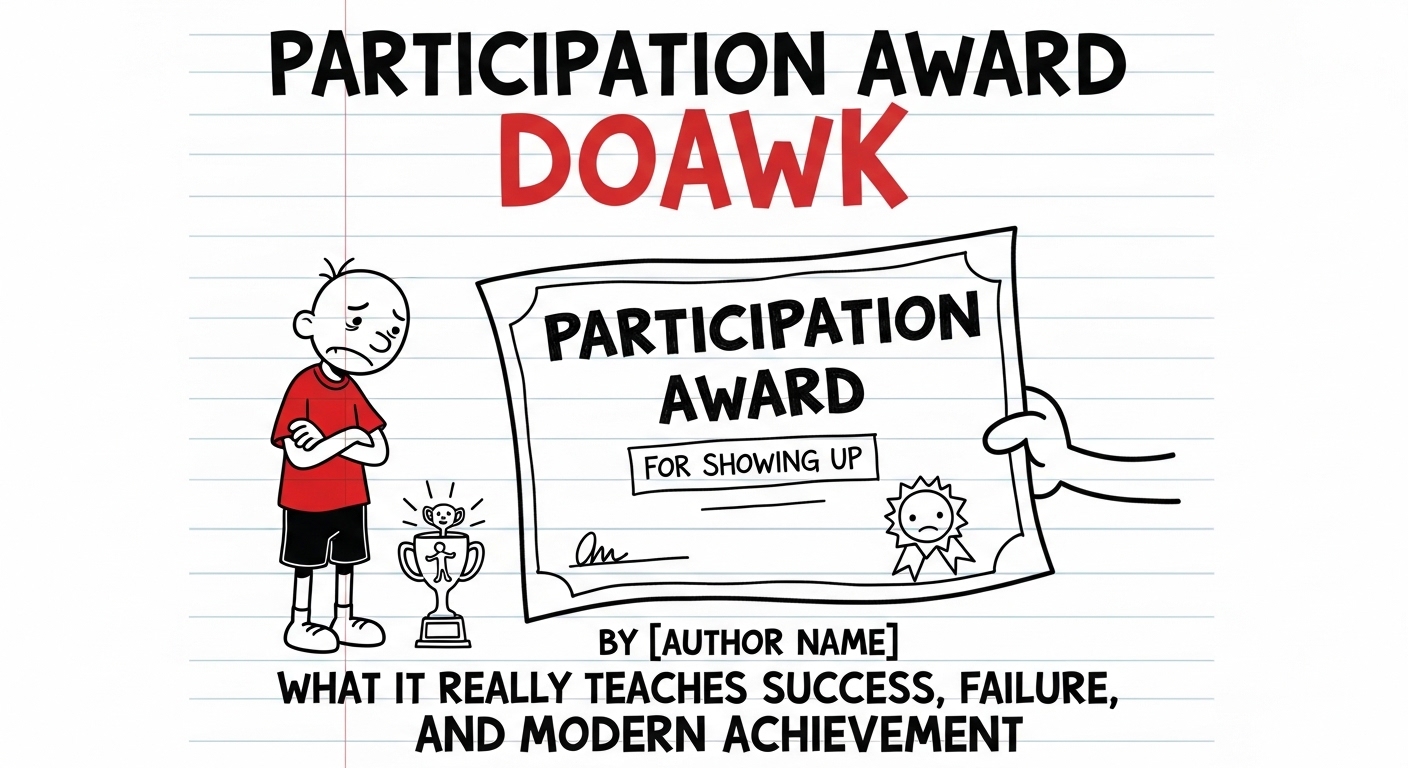
In a world where startup founders pitch bold visions, engineers ship imperfect products, and entrepreneurs risk public failure, the idea of a participation trophy feels almost laughably soft. Yet the phrase participation award DOAWK has sparked surprisingly serious conversations about effort, entitlement, resilience, and what we choose to reward. If you’ve read Diary of a Wimpy Kid, you already know the scene. If you haven’t, the lesson still lands.
For founders and digital professionals navigating high-stakes environments, the cultural meaning behind that fictional participation award is more relevant than it first appears.Let’s unpack why.
The Participation Award DOAWK Moment Explained
The phrase “participation award DOAWK” refers to a moment in the wildly popular book series Diary of a Wimpy Kid by Jeff Kinney. In one storyline, the main character, Greg Heffley, receives a participation award instead of a true competitive win.
The humor lands because the award feels hollow. It recognizes presence, not excellence. Greg doesn’t experience pride he experiences mild embarrassment. The joke works because most of us instinctively understand the difference between earning victory and being acknowledged for simply showing up.
But beneath the humor lies something more nuanced: what should participation mean? And when does recognition motivate versus dilute standards?In business, this question is anything but trivial.
Participation vs. Performance in the Startup World
In early-stage startups, nearly everyone receives a metaphorical participation award.
Investors applaud “the hustle.” LinkedIn celebrates “building in public.” Communities cheer the courage to launch. And that encouragement can be powerful. Founders need validation in the early days when metrics are thin and doubt is thick.
But markets don’t give participation trophies.
Customers either buy or they don’t. Users either stay or churn. Investors either fund or pass.
The tension between effort and outcome defines entrepreneurship. And that’s where the participation award DOAWK moment becomes a useful metaphor. It forces us to confront a core question:Are we rewarding effort because it leads to growth or because we’re uncomfortable with failure?The answer shapes culture.
The Psychology Behind Participation Awards
The debate over participation trophies isn’t new. Critics argue they breed entitlement. Supporters say they build confidence and encourage continued effort.From a performance psychology standpoint, both sides are partially right.
Recognition for effort can increase intrinsic motivation especially in early skill development. In a startup context, celebrating experimentation encourages teams to take risks without fear of punishment.
However, when recognition becomes disconnected from standards, it erodes meaning. Awards lose value when they are guaranteed.
In Greg Heffley’s case, the humor lies in that disconnect. The participation award DOAWK moment works because the award feels empty. It signals that everyone gets one regardless of performance.
In business, empty recognition looks like:
-
Praising ideas that never ship
-
Rewarding meetings over measurable progress
-
Confusing busyness with results
High-performing organizations avoid this trap by distinguishing between celebrating effort and rewarding achievement.
Why Founders Should Care About the Participation Award DOAWK Lesson
At first glance, a middle-school comedy book may not seem like required reading for tech leaders. But cultural signals shape generational attitudes toward work, feedback, and recognition.
Today’s workforce grew up in an era where participation awards were common. That doesn’t make them weak. It does mean expectations around feedback have evolved.
Modern professionals want:
-
Continuous feedback
-
Recognition for effort
-
Psychological safety
-
Clear performance standards
Balancing those four is leadership’s real challenge.
If you remove all recognition, morale suffers. If you remove standards, performance declines. The sweet spot lies in rewarding learning velocity, initiative, and measurable impact without pretending all outcomes are equal.
In other words, don’t mock the participation award DOAWK moment. Learn from it.
Effort vs. Outcome: A Practical Framework
Entrepreneurs operate in a results-driven environment. But not all outcomes are immediately visible. Early R&D, product iterations, and experimental marketing campaigns may fail publicly but succeed privately by generating insight.
Here’s a simple framework leaders can use to decide what deserves recognition:
| Scenario | Effort Level | Outcome Quality | Appropriate Recognition |
|---|---|---|---|
| Team experiments with new feature, gathers strong data | High | Valuable learning | Celebrate insight and iteration |
| Project misses deadline due to poor planning | Moderate | Negative impact | Constructive feedback, no award |
| Sales team hits revenue milestone | High | Strong performance | Public recognition and reward |
| Employee attends meetings but contributes little | Low impact | Neutral | Coaching, not celebration |
The distinction is clear: effort aligned with growth and measurable learning deserves recognition. Passive participation does not.
That’s the difference between meaningful encouragement and empty awards.
The Cultural Shift from Winning to Inclusion
The participation award DOAWK storyline mirrors a broader cultural shift over the past two decades. Schools and youth programs moved toward inclusive recognition models to prevent discouragement and dropout.In some contexts, that worked. Participation increased. Confidence grew. But competition didn’t disappear. It simply moved elsewhere.
Today, competition is global and digital. GitHub commits, product launches, funding rounds, and social proof are visible in real time. The scoreboard is public.For startup founders, this creates a paradox: internal culture may emphasize inclusivity, while external markets remain ruthlessly meritocratic.
Navigating that duality requires maturity. Leaders must build psychologically safe teams that can handle brutally honest market feedback.That’s where the real lesson lies.
When Participation Actually Matters
It’s easy to dismiss participation awards as symbols of softness. But participation itself is not trivial.
In entrepreneurship, participation means:
-
Shipping version 1.0
-
Raising your first round
-
Entering a competitive market
-
Publishing thought leadership
-
Applying for accelerators
Many professionals never even step into the arena.
There is courage in participation. There is growth in action. And in the early innings, participation is often the hardest step.
The mistake is not recognizing participation. The mistake is confusing it with victory.
Greg Heffley’s mild humiliation resonates because he understands he didn’t win. Deep down, most high performers want authentic achievement—not symbolic gestures.
Founders are no different.
Building a Culture Without Hollow Awards
So how do you avoid creating a workplace version of the participation award DOAWK scenario?
Start with clarity.
Define what winning looks like. Make success measurable. Then separate recognition into two categories:
-
Recognition for progress
-
Rewards for results
Progress recognition should highlight initiative, learning, resilience, and smart risk-taking. It tells teams, “You’re moving in the right direction.”
Results-based rewards should be tied to metrics: revenue, retention, efficiency, innovation breakthroughs.
When those lines blur, performance cultures weaken.
But when they’re clear, you create a powerful environment where people feel supported and challenged.
The Role of Failure in Modern Achievement
There’s another subtle lesson in the participation award DOAWK narrative: embarrassment. Greg feels it because he senses the gap between effort and excellence.In startups, embarrassment often appears as public failure missed launches, failed pivots, layoffs, funding rejections.
But unlike fictional middle-school awards, the real world provides brutally honest feedback. That’s not a flaw. It’s a feature.Markets reward value creation. They don’t distribute symbolic trophies.
Ironically, that clarity can be liberating. When you understand that participation alone isn’t enough, you stop seeking applause and start building substance.That’s where sustainable success begins.
Redefining What Deserves Applause
Maybe the real takeaway from the participation award DOAWK moment isn’t that participation awards are bad. It’s that recognition must align with purpose.
In education, encouraging shy students to join a team may deserve celebration. In business, showing up to a meeting does not.
Context matters.
Startup founders should ask themselves:
-
Are we celebrating comfort or courage?
-
Are we rewarding activity or impact?
-
Are we measuring what truly drives value?
When recognition reinforces behaviors that lead to excellence, it strengthens culture. When it masks mediocrity, it erodes trust.
Your team knows the difference even if they don’t say it.
The Deeper Message for Entrepreneurs
Entrepreneurship is inherently competitive. Yet it’s also deeply human. People crave acknowledgment. They want to feel seen for their work.The solution isn’t to eliminate recognition. It’s to make it meaningful.The participation award DOAWK storyline endures because it humorously exposes a disconnect between intention and authenticity. That same disconnect can quietly undermine organizations.
As a founder or leader, your job isn’t to hand out symbolic trophies. It’s to create conditions where real achievement is possible—and visible.When someone earns a win, it should feel unmistakable. When someone takes a brave risk, it should be recognized. And when someone simply coasts, it should be addressed constructively.That’s not harsh. That’s honest.
Conclusion:
The phrase participation award DOAWK may come from a comedic children’s series, but its cultural relevance extends far beyond middle school. It captures a tension every modern leader faces: how to encourage effort without diluting excellence.For startup founders, entrepreneurs, and tech professionals, the lesson is clear. Participation is the beginning, not the destination. Recognition should inspire growth, not replace achievement. And real confidence comes from competence, not consolation.
Markets reward value. Teams respect clarity. Individuals crave authentic accomplishment.The next time you think about handing out praiseor accepting it ask yourself whether it represents progress or merely presence.In business, as in life, the difference matters.